
Consulting services

Every pipeline, every column, one control plane.

Northlane models, runs and monitors your warehouse workloads from one place — with column-level lineage that resolves in seconds and no agents to install.

  • SOC 2 Type II
  • 180+ connectors
  • 99.99% uptime

Trusted by data teams at

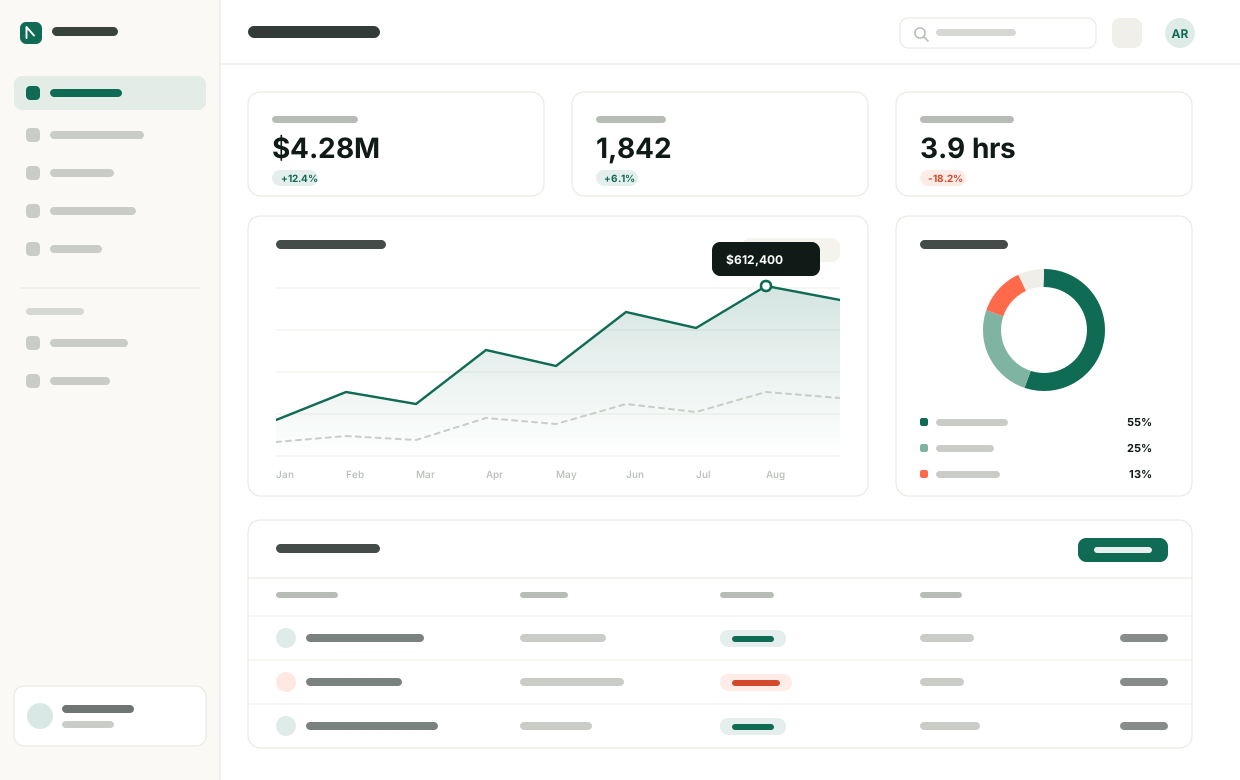
app.northlane.io/pipelines
Northlane pipeline analytics dashboard

What it changes

Measured across the 48 accounts that switched observability on first, comparing the quarter after cutover with the 90 days before it.

68 % Decrease, an improvement.

Fewer analyst-reported breakages

Breaks are caught by a contract rather than by somebody noticing a number looked wrong.

4.2 × Increase, an improvement.

Faster root-cause analysis

Alert to named upstream table fell from six hours of tracing to 85 minutes.

312 Increase, an improvement.

Engineering hours returned per quarter

Time the platform team had been spending walking broken dashboards backwards by hand.

Reported by customer platform teams, FY25. Methodology published alongside the figures.

IT Strategic advisory practice

Built for businesses that have outgrown Ad-Hoc IT

Productized advisory for growing businesses — from cost cleanup and SaaS sprawl to fractional executive oversight — built for organizations of 10 to 250+ employees.

  • Foundation & efficiency The entry point for small and growing businesses without internal IT leadership. This category first stabilizes spending,licensing, and core tooling to establish budget predictability, then attacks the manual, fragmented workflows that quietlydrain employee hours. Light-touch but continuous, it installs the operational hygiene and cost discipline that everythingabove it depends on.
  • Transformation & scale The bridge between a stabilized foundation and an enterprise-grade operating base. This category handles the heavylifting of moving off aging infrastructure and introductory software — full cloud migrations and structured ERP, CRM, orField-Service selection — with the firm serving as the client's official technology representative to keep third-partyengineering on time and on scope throughout the transition.
  • Leadership & assurance The top of the program provides a continuous seat at the leadership table, and deliberately separates two distinct buyertriggers. Tier 4 answers "we need a technology leader" — fractional vCIO governance, multi-year budgeting, and vendorcontrol. Tier 5 answers "we need to pass an audit and protect the business" — compliance readiness, disastercontinuity, and secure-AI guardrails. The two are sold as separate offerings and are frequently run together at the uppermid-market, where leadership capacity and assurance are needed at once.
northlane / contracts / fct_orders
A Northlane contract editor showing the arrival window, row-count band and null thresholds for a table

IT strategic Advisory Practice

Four jobs the graph does while nobody is watching it

Scroll the list and the console follows. Each step used to be work somebody did by hand on a Monday morning.

Northlane profiling a warehouse and writing baselines for each table

Implementation

From read-only credential to live coverage in three weeks

Every account runs the same sequence with a solutions engineer. Most teams are enforcing their first freshness contract on day two.

  1. Connect the warehouse

    Grant a read-only role in Snowflake, BigQuery, Redshift or Postgres. Northlane reads query history and metadata — no agents to install, no VPC peering, no copies of your data.

    Day 1 · 20 minutes

  2. Mark the tables that matter

    Tag the 30 to 50 tables your revenue, product and finance reporting actually depends on. Column-level lineage is traced upstream from there, including through dbt models and reverse-ETL syncs.

    Week 1

  3. Write the first contracts

    Declare what good looks like per table — arrival window, row-count band, null and uniqueness thresholds — then set who is paged when the contract fails. Templates cover the common shapes.

    Week 2

  4. Go live with routing

    Breaches open in Slack and PagerDuty with the failing column, the upstream job and every affected dashboard already attached. Nothing else changes in your stack.

    Week 3 · Ongoing

Rollout

From read-only credential to enforced contracts in three weeks

The same sequence runs on every account, with a solutions engineer on the call for the first two stages. Teams that already know which tables matter tend to finish it in half the time.

  1. Step 01

    Grant a read-only role

    Twenty minutes in Snowflake, BigQuery, Redshift or Postgres. Northlane reads query history and metadata over the connection you already have — no agents, no VPC peering, no copies of your data.

    Day 1 · 20 minutes

  2. Step 02

    Let the baselines settle

    Thirty days of history are profiled on connect, so the first contracts arrive as proposals you edit rather than thresholds you have to invent from memory.

    Day 1 · automatic

  3. Step 03

    Enforce the first fifty tables

    Start with the tables the board deck and the forecast read from. Contracts are generated per table and reviewed together in a single working session.

    Week 1

  4. Step 04

    Point the alerts at your rota

    Breaches open in Slack and PagerDuty against the owning team, with the failing column, the upstream job and the affected dashboards already attached. Nothing else in your stack changes.

    Week 2 · ongoing

Also included

Six things you stop building yourself

None of these are add-ons. They are what becomes cheap once every table already has a baseline, an owner and a place in the graph.

Schema-change alerts

An upstream rename or type change is picked up on the next metadata sync, typically inside five minutes, and traced to everything it touches.

Anomaly baselines

Seasonality, weekday shape and growth trend are modelled per table, so the thresholds move with the business instead of being re-tuned every quarter.

Incident timelines

Every breach keeps a record: what fired, who acknowledged it, what changed and which run cleared it. Post-mortems stop being an archaeology exercise.

New in 4.0

Quality scorecards

Coverage, breach rate and time to resolution per domain, so data quality carries a number a director can read without a translator.

Auto-pause downstream

Runs that would propagate bad rows hold until a human acknowledges the breach, then resume in dependency order without a manual backfill plan.

Related connectors

Where observability reads from, and where it pages to

Six connectors that matter to a monitoring rollout. Warehouses supply the metadata, schedulers explain the delay, and the rest receive the alert.

Native

Lakeframe

Snapshot history and table-format metadata read from the catalogue, so contracts work on open tables as well as managed ones.

Beta

Parallax DB

MPP metadata reads with per-query cost attribution, so a breach carries the compute it wasted alongside the rows it spoiled.

Native

Pagewire

On-call rota and escalation policy read directly, so Northlane never invents a paging order of its own.

Evaluation questions

What practitioners ask before they turn it on

The answers we give on technical evaluation calls, written down. If one of them reads as vague, tell us and we will rewrite it.

Question not covered here?

Solutions engineers answer directly — no ticket queue, no chatbot. Most replies land inside four working hours.

Ask an engineer

A new table starts with the contract you write by hand — usually an arrival window and a minimum row count. Northlane marks it as unbaselined so nobody mistakes a guess for a learned threshold.

After 14 loads the learned baseline takes over and the manual thresholds become bounds rather than the rule. You can pin a threshold permanently if a table has a business reason not to drift.

Yes, and we would rather you did. Northlane delivers into Slack, Microsoft Teams, PagerDuty and Opsgenie, and reads your existing rota so it never invents a second escalation order.

Anything else can consume the webhook, which carries the failing column, the upstream job, the blast radius and the incident URL as structured JSON.

Most checks read from information schema and query history, which costs nothing. Distribution and uniqueness checks do run queries, and they are batched per table and scheduled outside your reporting windows by default.

Typical overhead across our customer base is under 1.5% of monthly warehouse spend, and every check reports its own cost so you can switch off any that are not earning their place.

Start here

Put a contract on your fifty most-read tables this week

The trial connects a read-only role, profiles thirty days of history and proposes the first contracts before you have finished reading the docs. Nothing to install.

14 days, no credit card. Read-only access you can revoke yourself.

  • 9 days Median time to the first enforced freshness contract
  • 12,400 Production tables under contract across customer accounts
  • 99.98% Freshness SLA held on monitored tables last year